What Is a Subway, Bus or Train Accident Case Worth in NYC?
By Nico SteelePublished · 5 min read

A claim against the subway, a city bus or a commuter railroad has deadlines far shorter than the usual three years. Here is what these cases have recovered in New York City, and what to do if you were hurt.
The numbers
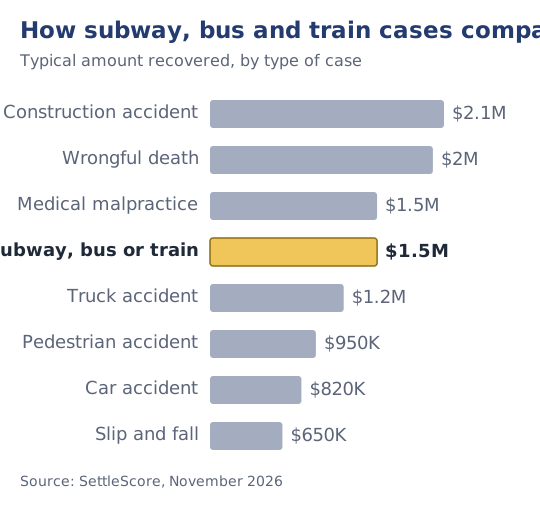
The typical subway, bus or train accident case recovered $1.5 million. That means half of the cases recovered more, and half recovered less.
About two out of three cases recovered $1 million or more. Only about 1 in 37 recovered under $100,000.
The chart below shows how many subway, bus and train cases recovered each amount. Each bar is a range of dollar amounts, and the longer the bar, the more cases ended in that range. The gold bar is the range where the typical case falls.
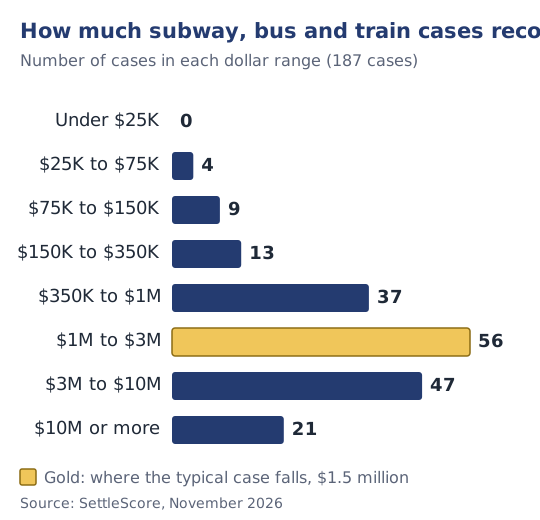
These figures come from 187 subway, bus and train accident wins that New York City law firms list on their websites. Each amount is the total the case recovered, before the lawyer's fee and other costs come out.
Why these cases are worth more than most
The chart below compares the typical recovery for subway, bus and train accidents with seven common kinds of injury cases, from highest to lowest. Subway, bus and train accidents are in gold.
The injuries can be severe
Being hit by a train or a bus, or falling onto the tracks, can cause the most serious injuries: amputations, brain injuries and deaths. Serious injuries recover the most.
Subway riders are outside no-fault
A subway train isn't a motor vehicle under New York law, so no-fault insurance doesn't apply to subway injuries, and neither does the "serious injury" test. Your own health insurance, if you have it, pays your medical bills, and your claim can include those bills and your lost pay.
Bus riders are covered by no-fault
A bus is a motor vehicle. If you were hurt on a bus, no-fault insurance pays your first medical bills and part of your lost pay, no matter who caused the crash. If you or a relative you live with has car insurance, that policy pays first. If not, the bus's insurer pays. To get money for pain and suffering after a bus crash, your injury has to count as "serious" under New York law. A broken bone counts, and so does a significant or permanent limitation in how part of your body works.
Public agencies get short deadlines
A subway or city bus claim is usually against NYC Transit, the part of the MTA that runs the subway and most city buses. A claim against NYC Transit usually starts with a notice of claim, a short sworn form that must be served within 90 days. The lawsuit must generally be filed within 1 year and 90 days, or within 2 years of a death in a wrongful death case. The Long Island Rail Road and Metro-North work differently: there is no notice of claim, but you must make a written demand and wait 30 days before suing, and the lawsuit deadline is the same. Our notice of claim guide explains which agency to serve and how.
Injuries that raise the value
The injury makes a big difference. Here is what injury cases of every kind in our records typically recovered, by the injury they name.
| Injury | Typical recovery |
|---|---|
| Sprain, strain or other soft-tissue injury | $475,000 |
| Broken bone | $750,000 |
| Any injury that needed surgery | $1 million |
| Death | $1.98 million |
| Amputation | $2.98 million |
| Traumatic brain injury | $3.3 million |
| Spinal cord injury or paralysis | $5.68 million |
What to do if you were hurt
- Get medical care, and ask for the incident report number if transit workers or the police responded.
- Write down the line or route, the train or bus number, the direction, the station or stop and the time.
- Photograph the scene and your injuries, and get the names of witnesses, including other passengers.
- Serve the notice of claim within 90 days. Claims against NYC Transit go to NYC Transit directly, not to the City Comptroller.
- If you were hurt on a bus, file for no-fault quickly. Give the insurer written notice within 30 days, and send medical bills within 45 days of treatment.
- Compare lawyers by their results. SettleScore's NYC subway, bus and train accident rankings rank firms by the cases they have won. Firms can't pay to rank higher.
Rules that can lower a case's value
Blame matters. The transit agency may say you were rushing for a closing door or standing too close to the platform edge. If you were partly to blame, your recovery goes down by your share. For example, if you were 20% to blame, you get 80%. For most bus crash lawsuits filed on or after May 26, 2026, a person more to blame than the people they are suing can't recover damages from them.
How to read these numbers
- Law firms choose which wins to list, so these figures likely run higher than what most cases recover. Public records show how wide the gap can be: across 1,020 payments by the MTA and NYC Transit, the typical payment was $50,000.
- The amounts are what the case recovered in total. The lawyer's fee, case costs and medical bills that must be paid back come out first. SettleScore's settlement calculator shows what you would keep.
- Each law firm has an office in New York City, but the accident may have happened somewhere else, such as on a commuter train line outside the city.
This article gives general information about New York law and recoveries published by law firms. It is not legal advice. Talk with a New York injury lawyer about your own case.
Sources
- Recoveries: SettleScore's records of settlements and verdicts published by law firms with a New York City office, as of November 15, 2026: 190 subway, bus and train accident recoveries from 92 firms, 187 of them with an exact amount. The middle half of those 187 fell between $762,500 and $4.76 million. Injury figures: SettleScore's records of recoveries that name the injury, as of November 13, 2026. See how SettleScore works.
- Trains aren't motor vehicles: New York Vehicle and Traffic Law § 125. The serious injury test applies to the use of a motor vehicle: New York Insurance Law § 5104.
- No-fault for bus passengers: New York Insurance Law § 5103, as explained by the New York State Department of Financial Services in OGC Opinion No. 08-07-29. No-fault deadlines: 11 NYCRR 65-1.1.
- MTA and NYC Transit payments: public records, as summarized in Suing the City, NYCHA or the MTA (1,020 payments).
- Notice of claim and deadlines: General Municipal Law § 50-e and Public Authorities Law § 1212. Long Island Rail Road and Metro-North: Public Authorities Law § 1276. See also our guide, Hurt on a City Bus? You Have 90 Days, Not Three Years.
- Sharing blame: CPLR 1411. 2026 changes: New York State Bar Association, New York State Law Digest, August 2026. The date these apply from: New York State Department of Financial Services, Insurance Circular Letter No. 3 (2026), lawsuits filed on or after May 26, 2026.
Compare Firms Handling Cases Like These
The top-ranked firms by SettleScore on their documented subway, bus, and train accident results. Firms can't pay to rank higher.
#1 Lipsig, Freund & Wisell, PLLC
ManhattanSettleScore 100 out of 10010 case results
#2 Kelner & Kelner
ManhattanSettleScore 88 out of 1007 case results
#3 Hecht, Kleeger & Damashek, P.C.
ManhattanSettleScore 75 out of 1005 case results