Suing the City, NYCHA or the MTA: What Public Agencies Pay and How Long It Takes
By Nico SteelePublished · 4 min read

If a City vehicle, a City street, a NYCHA building or a subway or bus hurt you, your claim is against a public agency. Here is what those agencies typically pay, how long it takes, and the deadlines you have to meet.
The numbers
SettleScore looked at injury payments and resolved cases against public agencies in New York, from City payment records, court decisions and news reports. The chart below shows how long a claim typically took to resolve, from the claim or lawsuit to payment, for the biggest public defendants.
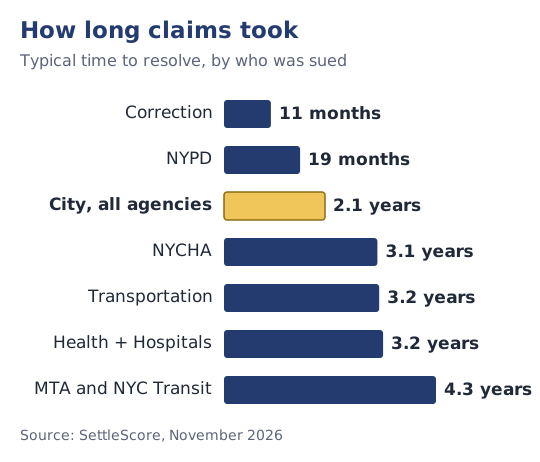
NYCHA, the MTA and other public agencies
| Who was sued | Payments | Typical payment | Typical time to resolve |
|---|---|---|---|
| NYCHA | 880 | $55,000 | 3.1 years |
| MTA and NYC Transit | 1,020 | $50,000 | 4.3 years |
| State of New York | 107 | $65,000 | 2.9 years |
| Port Authority | 49 | $75,000 | 3.7 years |
| Other cities, towns and counties | 69 | $310,000 | 3.2 years |
| Other public agencies | 84 | $57,500 | 3.6 years |
New York City agencies
| Who was sued | Payments | Typical payment | Typical time to resolve |
|---|---|---|---|
| City of New York, all agencies | 91,171 | $25,000 | 2.1 years |
| NYPD | 35,647 | $20,000 | 19 months |
| Department of Correction | 11,529 | $8,000 | 11 months |
| Department of Transportation | 8,921 | $35,000 | 3.2 years |
| Department of Education | 6,256 | $45,000 | 3.1 years |
| Department of Sanitation | 3,375 | $60,000 | 2.7 years |
| Parks & Recreation | 3,022 | $50,000 | 2.8 years |
| FDNY | 2,594 | $45,000 | 2.6 years |
| NYC Health + Hospitals | 1,013 | $175,000 | 3.2 years |
| Environmental Protection | 902 | $50,000 | 3 years |
| Housing Preservation & Development | 149 | $82,500 | 3.6 years |
| Homeless Services | 138 | $30,000 | 2.3 years |
| Administration for Children's Services | 95 | $60,000 | 2.9 years |
A case that names two agencies counts under each here, so these counts are a little higher than in our guide to what New York City pays for injury claims, which counts each payment once.
Why payments differ so much
Police and jail claims make up about half of the City's payments, and they are typically small: $20,000 for the NYPD and $8,000 for the Department of Correction. Many are civil-rights claims, such as false arrest. Claims against NYC Health + Hospitals, the City's public hospitals, typically paid $175,000.
The deadlines are short
Claims against public agencies run on a much shorter clock than the usual three years.
- New York City, NYCHA, NYC Health + Hospitals and NYC Transit: a notice of claim, a short sworn form, must be served within 90 days. The lawsuit must generally be filed within 1 year and 90 days, or within 2 years of a death in a wrongful death case. City claims go to the City Comptroller, but claims against NYCHA, NYC Health + Hospitals and NYC Transit go to that agency directly.
- New York State: claims go to the New York State Court of Claims. A claim for an injury caused by carelessness must be filed, or a notice of intention served, within 90 days.
- The Port Authority: a notice of claim must be served at least 60 days before you sue, and the lawsuit must be filed within one year.
Our notice of claim guide explains which agency to serve and how.
What to do if a public agency hurt you
- Get medical care, and keep your records.
- Write down exactly where and when it happened, and photograph the spot, such as the broken sidewalk, the bus or the stairwell.
- Find out which agency is responsible. Buses and buildings that look alike can belong to different agencies.
- Serve the notice of claim within 90 days, and keep proof that you did.
- Know what cases like yours recover. Our guides to subway, bus and train cases and falls show what they have recovered.
How to read these numbers
- The time to resolve runs from when the claim or lawsuit was filed until it was paid or otherwise resolved. Only resolved cases are counted.
- The payments come from public records, including the City's payment records, court decisions and news reports. The figures are as of November 13, 2026.
- A typical payment is the middle amount: half of the payments were higher, and half lower.
This article gives general information about New York law. It is not legal advice. Talk with a New York injury lawyer about your own case.
Sources
- Payments and time to resolve: SettleScore's records of injury payments and resolved cases against public defendants, from City of New York payment records, court decisions and news reports, as of November 13, 2026. See how SettleScore works.
- Notice of claim and deadlines: General Municipal Law § 50-e, General Municipal Law § 50-i and Public Authorities Law § 1212. Where to serve: NYC Comptroller, File a Claim and Personal injury claim FAQs.
- Claims against New York State: Kiesow v State of New York, 161 A.D.3d 1060 (2d Dept. 2018), on Court of Claims Act § 10(3).
- Claims against the Port Authority: Espinal v Port Auth. of N.Y. & N.J., 213 A.D.3d 101 (2d Dept. 2023), on Unconsolidated Laws § 7107.