Will My Car Accident Injury Count as Serious? New York's Serious Injury Test
By Nico SteelePublished · 4 min read

If you were hurt in a car crash, the insurance company may say your injury isn't "serious" enough to sue over. Here is what New York's test requires, how often appeals courts throw claims out over it, and how to protect your case.
What the test is
New York's no-fault insurance pays your medical bills and part of your lost pay after a crash, no matter who caused it. In exchange, you can sue the other driver for pain and suffering only if your injury counts as "serious." That covers:
- A death.
- Losing a body part, or significant disfigurement.
- A broken bone.
- Losing a pregnancy.
- Permanently losing the use of a body organ, part, function or system.
- A permanent and important limitation in how a body organ or part works.
- A significant limitation in how a body function or system works.
For lawsuits filed on or after May 26, 2026, one older category was removed from the list: an injury that kept you from your usual activities for 90 of the first 180 days.
The test applies to people hurt in cars, trucks and buses, to pedestrians and to cyclists hit by a vehicle. It doesn't apply to motorcycle riders, who are outside no-fault, or to injuries that don't involve a motor vehicle, such as a fall or a subway accident.
How often claims fail on appeal
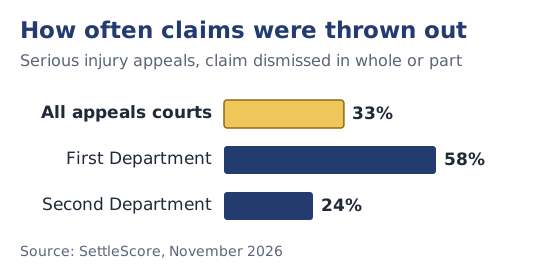
The other side can ask the judge to throw out the pain and suffering claim before trial, arguing that the injury isn't serious. The losing side can appeal. SettleScore looked at 286 of those appeal rulings, decided from 2016 to 2026 by New York's Appellate Division. The chart below shows how often the claim was thrown out, in whole or in part.
By appeals court
| Appeals court | Rulings | Claim dismissed, in whole or in part | Claim went forward |
|---|---|---|---|
| First Department (Manhattan and the Bronx) | 74 | 58% | 42% |
| Second Department (Brooklyn, Queens, Staten Island, Long Island and the lower Hudson Valley) | 205 | 24% | 76% |
| All appeals courts | 286 | 33% | 67% |
The Appellate Division is split into four departments. The First Department hears appeals from Manhattan and the Bronx, and the Second Department from Brooklyn, Queens, Staten Island, Long Island and the lower Hudson Valley. The Third and Fourth Departments had too few rulings to show.
By year
| Year | Rulings | Claim dismissed, in whole or in part |
|---|---|---|
| 2018 | 33 | 18% |
| 2019 | 51 | 39% |
| 2020 | 39 | 46% |
| 2021 | 25 | 48% |
| 2022 | 36 | 33% |
| 2023 | 34 | 21% |
| 2024 | 27 | 19% |
| 2025 | 17 | 18% |
| 2026 (so far) | 22 | 45% |
Years before 2018 had fewer than 10 rulings each and aren't shown.
What courts look for
- Objective proof. Pain alone isn't enough. Courts want measurements, such as range of motion compared with normal, along with tests like MRIs. An MRI showing a herniated disc isn't enough by itself without proof of real physical limits.
- Steady treatment. If you stopped treatment, you need a reasonable explanation, such as a doctor saying more therapy wouldn't help, or losing coverage.
- A link to the crash. If you had an earlier injury or condition in the same area, your doctor has to explain why the crash caused your current problems.
What to do after a crash
- See a doctor right away, and keep going to your appointments.
- Tell every doctor about every symptom, and about any earlier injury to the same area.
- If you have to stop or pause treatment, write down why.
- File for no-fault quickly. Give the insurer written notice within 30 days of the crash.
- Know what your kind of case recovers. Our car accident guide and injury guide show what cases like yours have recovered.
How we did this
These are Appellate Division decisions from 2016 to 2026 in which a law firm listed on SettleScore was counsel, not every appeal decision on these motions. They are appeals only: trial-court rulings that nobody appealed aren't in published decisions. A ruling counts as throwing out the claim if it dismissed it, in whole or in part, for failing the serious injury test. No firm is named. The figures are as of November 13, 2026.
This article gives general information about New York law. It is not legal advice. Talk with a New York injury lawyer about your own case.
Sources
- Rulings: SettleScore's records of published Appellate Division decisions, as of November 13, 2026. See how SettleScore works.
- The test: New York Insurance Law § 5102(d) and § 5104. The 2026 change: New York State Bar Association, New York State Law Digest, August 2026. The date these apply from: New York State Department of Financial Services, Insurance Circular Letter No. 3 (2026), lawsuits filed on or after May 26, 2026.
- Motorcycle riders: New York Insurance Law § 5102(f) and (j) (a motorcycle isn't a "motor vehicle" under the no-fault law) and § 5104(a) (the test applies to lawsuits between people the no-fault law covers).
- What courts look for: New York Court of Appeals, Pommells v Perez, 4 N.Y.3d 566 (2005), and New York State Bar Association, Serious Injury Threshold in New York: 5 Things You Need to Know.
- No-fault deadlines: 11 NYCRR 65-1.1.
- The four Appellate Division departments: New York State Unified Court System, Appellate Divisions.
Compare Firms Handling Cases Like These
The top-ranked firms by SettleScore on their documented car accident results. Firms can't pay to rank higher.
#1 Block O'Toole & Murphy, LLP
ManhattanSettleScore 99 out of 10084 case results
#2 Subin Associates, LLP
ManhattanSettleScore 98 out of 10064 case results
#3 Torgan Cooper + Aaron
ManhattanSettleScore 95 out of 10037 case results