NYC Building Collapses: Your Rights, the Warning Signs and the Data
By Nico SteelePublished · 11 min read
On Wednesday, Nov. 11, 2026, a three-story building at 1321 Flatbush Ave. in Brooklyn collapsed into an excavation on the construction site next door. Eight people died, including two children, and at least 18 were hurt.
This guide explains what is known so far about that collapse. It then maps, ZIP code by ZIP code, where New Yorkers have reported warning signs like shaking walls and unsafe digging next door since 2021. The rest covers who can be held responsible when a building fails, what injured people and families can claim, and the deadlines that apply.
In this guide
- What happened in Flatbush: what investigators and city records show so far
- The five-borough picture: the deadliest collapses, a borough comparison and the 10 ZIP codes with the most warning signs
- The warning signs, and what inspectors found: what to watch for, and how often complaints led to action
- Who can be held responsible
- Your rights depend on who you are: tenants, workers, pedestrians, families and businesses
- Deadlines you cannot miss
- What to do in the first days
- How to check your own building
What happened in Flatbush
Just after 4 p.m. on Wednesday, Nov. 11, the three-story building at 1321 Flatbush Ave. fell into an open excavation at 2625 Bedford Ave. Eight people were killed, including two children and two construction workers, and at least 18 were hurt (The Real Deal; ABC7).
Here is what public records and officials have said so far:
- The building: 96 years old, with a store at street level and apartments upstairs. It had 98 open housing violations before the collapse.
- The site next door: A one-story commercial building was torn down this year to make way for a new apartment building. DOB says the developer held permits for excavation and foundation work.
- Earlier warnings: In March, DOB cited the demolition contractor, with a $2,500 penalty, for starting work without overhead protection for neighbors, and issued a stop-work order. In April, inspectors found demolition had continued anyway, which brought a $10,000 penalty. The order was lifted in May (Brooklyn Paper; amNY).
- Now: Vacate orders cover 1323, 1325 and 1327 Flatbush Ave. DOB, the NYPD and the Brooklyn District Attorney are investigating. The city has widened inspections to 160 sites tied to six companies involved in the project (The City Reporter).
The cause has not been officially determined. Whether the excavation played a role is the central question investigators are weighing.
The five-borough picture
Building failures happen in every borough, and the warnings before them are logged by the thousands. SettleScore's collapse log lists 65 collapses and near-collapses since 2008. The 18 we verified in detail killed 34 people.
| Date | Where | What happened | Deaths | Injuries |
|---|---|---|---|---|
| Nov. 11, 2026 | Flatbush, Brooklyn | Building fell into the excavation next door | 8 | 18 |
| Mar. 12, 2014 | East Harlem, Manhattan | Gas explosion leveled two buildings | 8 | About 50 |
| Mar. 15, 2008 | Turtle Bay, Manhattan | Tower crane collapsed onto homes | 7 | 24 |
| Mar. 26, 2015 | East Village, Manhattan | Gas explosion destroyed three buildings | 2 | 19 |
| May 30, 2008 | Yorkville, Manhattan | Crane cab fell 12 stories | 2 | 1 |
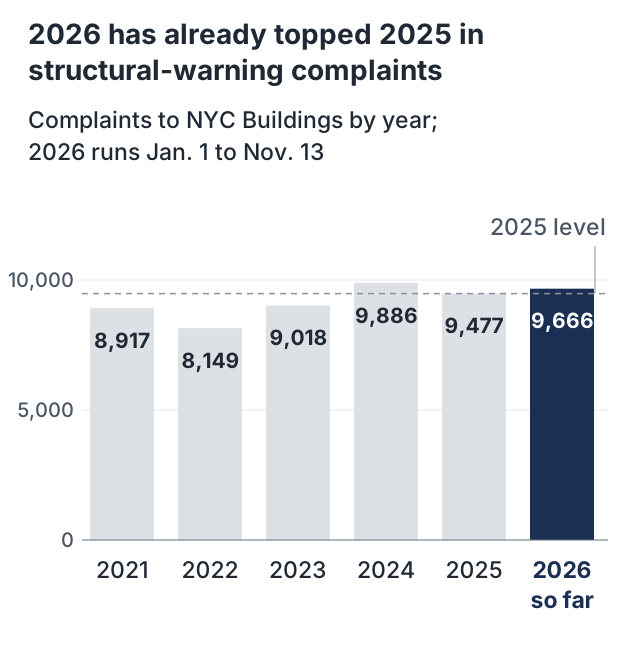
Source: NYC Open Data, DOB Complaints Received, nine structural-warning categories, Jan. 1, 2021 to Nov. 13, 2026.
At about 30 complaints a day, 2026 is on pace to pass 2024's high within weeks.
By borough
Manhattan has the most warnings per building, partly because its buildings are bigger and hold more people. Brooklyn has the most warnings overall and the most complaints about crews defying stop-work orders.
| Borough | Warning complaints since 2021 | Per 1,000 buildings | Work after a stop-work order | Buildings with an unsafe facade |
|---|---|---|---|---|
| Manhattan | 11,427 | 284 | 1,721 | 796 |
| Bronx | 7,590 | 90 | 979 | 278 |
| Brooklyn | 22,942 | 86 | 6,577 | 316 |
| Queens | 11,024 | 35 | 2,237 | 131 |
| Staten Island | 2,105 | 18 | 501 | 14 |
ZIP codes with the most warning signs
The SettleScore Structural Warning Score rates 168 residential ZIP codes from 0 to 100. It blends complaints, inspector-confirmed problems, construction-next-door complaints and unsafe facades. Five of the top 10 are in Brooklyn.
| Rank | ZIP | Neighborhood | Borough | Score |
|---|---|---|---|---|
| 1 | 10018 | Midtown South / Garment District | Manhattan | 96 |
| 2 | 10013 | SoHo, Tribeca, Chinatown | Manhattan | 87 |
| 3 | 11205 | Fort Greene, western Bed-Stuy | Brooklyn | 86 |
| 4 | 11249 | Williamsburg | Brooklyn | 84 |
| 5 | 11225 | Prospect Lefferts Gardens, Crown Heights | Brooklyn | 83 |
| 6 | 10031 | Hamilton Heights, Sugar Hill | Manhattan | 82 |
| 7 | 11206 | East Williamsburg, western Bed-Stuy | Brooklyn | 82 |
| 8 | 10457 | Tremont, Mount Hope | Bronx | 81 |
| 9 | 11211 | Williamsburg, East Williamsburg | Brooklyn | 80 |
| 10 | 10009 | East Village | Manhattan | 79 |
Flatbush's 11226 ranks 47th, in the "High" tier. It logged 734 warning complaints since 2021, and 89% of its buildings went up before 1940.
The warning signs, and what inspectors found
The most common warning is a building that shakes or seems to lose stability: 24,044 complaints since 2021. Of those, 3,298 ended with DOB ordering people out of all or part of the building.
Complaints that a crew kept working after a stop-work order rarely led to action. Of 12,017 such complaints, 14.5% ended with a violation, a new stop-work order or a vacate order. In 65.9%, the inspector found nothing to cite at the time of the visit. In another 12.9%, the inspector could not get in.
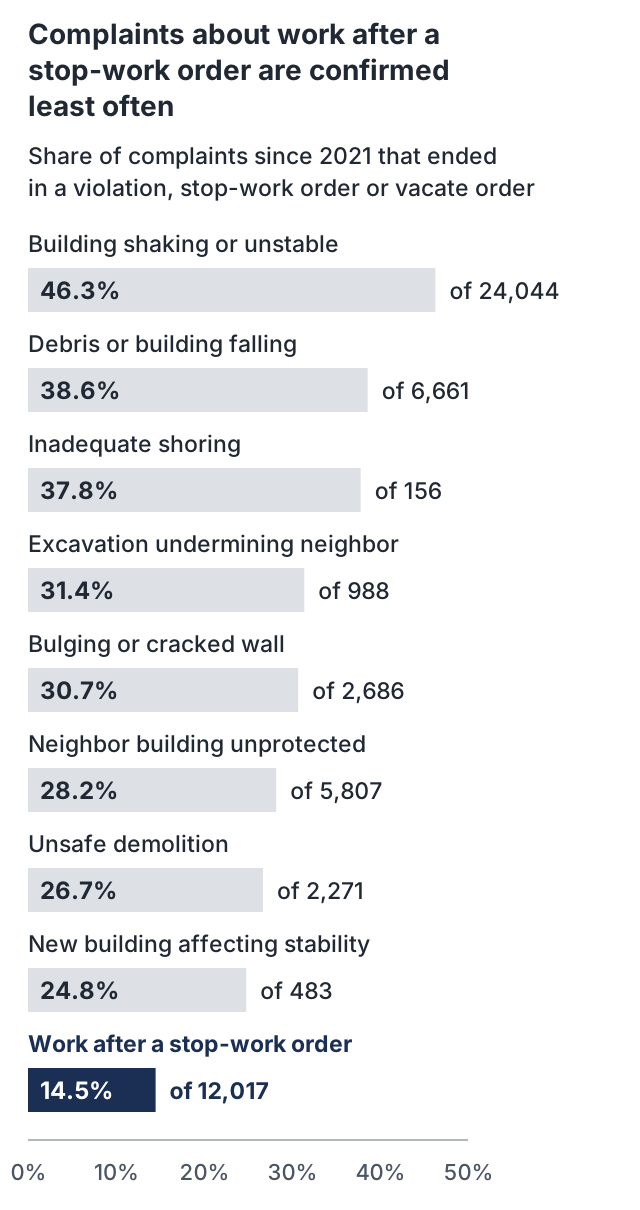
Source: NYC Open Data, DOB Complaints Received, latest outcome per complaint, Jan. 1, 2021 to Nov. 13, 2026.
A finding of "no violation" does not mean a complaint was false. Crews can stop before an inspector arrives and restart after.
Warning signs to report
Call 311 or file online if you notice any of these. If walls are moving or debris is falling, leave and call 911.
- New cracks, especially diagonal cracks above doors and windows
- Doors or windows that suddenly stick or will not close
- Floors that start to slope, or walls that bulge
- Brick, mortar or facade pieces falling
- Shaking or new cracks when digging or demolition starts next door
- A gap opening between your building and a construction site
- An excavation dug along your wall with no visible shoring or bracing
- Work going on behind a posted stop-work order
Who can be held responsible
A collapse usually has more than one cause, so an injury claim often names more than one party. A jury can divide the fault among them.
| Who | Why they may be responsible |
|---|---|
| Owner of the building that failed | City law requires owners to keep buildings and every part of them safe (NYC Admin. Code §28-301.1). Apartment owners must also keep buildings in good repair (Multiple Dwelling Law §78). |
| Developer and owner of the site next door | Whoever causes an excavation must protect neighboring buildings at its own cost (NYC Building Code §3309.4). New York's top court held that the older version of this rule imposes absolute liability for excavation damage to a neighbor's property, and later courts apply the same to today's rule (Yenem Corp. v. 281 Broadway Holdings, 2012; see a later decision applying it). |
| Contractors and subcontractors | Firms that dig, demolish, shore or brace can be liable when they skip safety steps or ignore city orders. |
| Engineers and inspectors | Professionals who sign plans or reports can be liable for errors. DOB found the 2023 Bronx collapse at 1915 Billingsley Terrace began with an engineer's mistake (DOB). |
| Utilities | Gas companies can be responsible for explosions. Con Edison agreed to a $153 million settlement with state regulators after the 2014 East Harlem blast (CBS). |
| NYCHA or another public owner | A public agency that owns the building is treated much like a private landlord, with shorter deadlines. |
| The city as inspector | Suing the city for missed inspections is hard. New York courts generally require a special duty owed to the injured person. |
New York lets an injured person recover even when partly at fault, with the award reduced by that share. The 2026 change that bars mostly-at-fault plaintiffs applies only to certain car-crash suits, not building or construction cases (Lawyer Monthly).
Your rights depend on who you are
What you can claim, and from whom, turns on how the collapse reached you.
| If you are | What you can usually seek | Know this |
|---|---|---|
| A tenant or resident | Medical costs, lost pay, pain and suffering, and the value of belongings lost | If a vacate order puts you out, ask HPD's Emergency Housing Services about relocation (212-863-7660). Rent-stabilized and rent-controlled tenants can apply to lower rent to $1 a month while they cannot live there (DOB). |
| A construction worker | Workers' compensation from your employer, regardless of fault, plus a lawsuit against the owner or general contractor | New York's Labor Law §240(1) and §241(6) hold owners and contractors responsible for certain safety failures. Immigration status does not bar a claim; the state's top court allowed undocumented workers to recover lost wages in Balbuena v. IDR Realty (2006). |
| A pedestrian or neighbor | Medical costs, lost pay and pain and suffering; repair costs if your building was damaged | Damage from an excavation next door falls under the strict-liability rule above. |
| A family that lost someone | The person's lost earnings and support, medical and funeral costs, and the pain they suffered before death | New York does not pay families for grief. Gov. Hochul vetoed the Grieving Families Act a fourth time on Dec. 5, 2025 (Spectrum News). |
| A business owner | Damaged property, inventory and lost income | A pizzeria forced out by excavation damage next door was a plaintiff in the Yenem case. |
Deadlines you cannot miss
The shortest deadline applies whenever a public agency such as the city or NYCHA may share the blame: 90 days. Missing a deadline can end a claim for good.
| What | Deadline | Law |
|---|---|---|
| Notice of claim against the city, NYCHA or another public agency | 90 days from the collapse | General Municipal Law §50-e; Public Housing Law §157 |
| Lawsuit against the city or NYCHA | 1 year and 90 days | General Municipal Law §50-i |
| Wrongful death lawsuit | 2 years from the death | Estates, Powers and Trusts Law §5-4.1 |
| Injury lawsuit against an owner, developer or contractor | 3 years | CPLR 214(5) |
| Property damage lawsuit | 3 years | CPLR 214(4) |
| Workers' compensation | Tell your employer within 30 days; file within 2 years | Workers' Compensation Law §§18, 28 |
Deadlines can run differently for children and in some other cases. A lawyer can confirm the dates for your situation.
What to do in the first days
Get care first, then protect your records. Evidence at a collapse site is cleared quickly.
- Get checked by a doctor, even if you feel fine. Crush injuries, concussions and dust inhalation can show up days later. Keep every bill and discharge note.
- Follow FDNY and DOB orders. Do not go back into a building under a vacate order. Register at the city or Red Cross reception center, or call 311.
- Ask about housing help. If you are displaced, call HPD's Emergency Housing Services at 212-863-7660.
- Document what you can. Take photos and video of your home, cracks, posted notices and the site next door. Save texts and emails with the landlord, and every receipt.
- Save the public record now. Print or screenshot the DOB and HPD pages for your building and the one next door. Records can be updated after an incident.
- Be careful with insurers. An insurer for the owner, developer or contractor may call. You do not have to give a recorded statement or sign a release.
- Mark your deadlines. If the city or NYCHA could be involved, the 90-day notice clock is already running.
- Talk to an injury lawyer who handles collapse and construction cases. Most work on contingency, so you pay nothing up front. Compare NYC injury firms by their recorded results on SettleScore.
How to check your own building
Four free lookups show most of what the city knows about a building. Check the lot next door too, especially if work is under way.
| Tool | What it shows | Where |
|---|---|---|
| DOB Building Information System | Complaints, violations, stop-work orders and vacate orders | a810-bisweb.nyc.gov |
| DOB NOW public portal | Recent permits, including excavation, foundation and shoring work | a810-dobnow.nyc.gov |
| HPD Online | Housing violations, such as leaks, exposed wiring or failing walls | hpdonline.nyc.gov |
| NYC 311 | Report shaking, cracking, unsafe excavation or work after a stop-work order | portal.311.nyc.gov |
On the street, look at the construction fence. Permits must be posted there, and a posted stop-work order means work must stop.
About this data
SettleScore built this dataset from public city records pulled Nov. 14-15, 2026. A complaint is a report from the public, not proof of danger.
- Warning complaints: DOB complaints in nine categories from Jan. 1, 2021, to Nov. 13, 2026: building shaking or losing stability, falling debris or building, bulging or cracked walls, an unprotected neighboring building, excavation undermining a neighbor, inadequate shoring, unsafe demolition, new construction affecting stability, and work after a stop-work order (NYC Open Data; DOB category list).
- Inspector-confirmed: complaints whose latest DOB outcome was a violation, a stop-work order or a vacate order (DOB outcome codes).
- Unsafe facades: buildings whose latest facade inspection report in the current or prior cycle was filed as unsafe (NYC Open Data).
- Construction accidents: DOB's incident database, Jan. 2024 to Nov. 11, 2026 (NYC Open Data). Its Flatbush entries were still preliminary.
- Buildings and homes: lots with buildings and residential units from the city's PLUTO file, version 26v2 (NYC Open Data).
- Collapse log: 18 major incidents verified through news and government reports, plus 47 collapse alerts the city broadcast through Notify NYC from 2008 to 2024 (NYC Open Data). The alerts cover only incidents the city chose to broadcast.
- The score: warning complaints (35%), inspector-confirmed problems (35%), construction-next-door complaints (15%) and unsafe facades (15%). The first three are measured both per 1,000 buildings and per 10,000 homes, so neither big buildings nor small homes skew the result. ZIPs are ranked by percentile; 168 ZIPs with at least 250 buildings and 1,500 homes qualify.
Sources
- Collapsed Flatbush building, adjacent job site have history of violations, The Real Deal, Nov. 12, 2026
- Brooklyn building collapse live updates, ABC7 New York
- City targets construction site beside Flatbush building collapse, Brooklyn Paper
- Mamdani announces inspections at 100 sites linked to disaster, amNY
- Brooklyn collapse probe widens to construction sites across the city, The City Reporter, Nov. 13, 2026
- City releases investigation report into 2023 Bronx building collapse, NYC Department of Buildings
- City suspends general contractor after Bronx wall collapse, NYC Department of Buildings, Jan. 22, 2026
- Vacate order FAQs, NYC Department of Buildings
- HPD orders and relocation services, NYC HPD
- Con Edison to pay $153 million for East Harlem explosion, CBS New York
- 2008 Manhattan crane collapse, Wikipedia
- East Village explosion defendants sentenced, NBC New York
- Hochul defends fourth veto of Grieving Families Act, Spectrum News, Dec. 9, 2025
- New York's 2026 auto tort reform: what changed, Lawyer Monthly
- NYC Open Data: DOB Complaints Received, Construction-Related Incidents, DOB NOW Facades Compliance Filings, PLUTO 26v2, NYCEM Emergency Notifications (linked above)
This guide is general information, not legal advice. SettleScore is not a law firm, and reading this guide does not create an attorney-client relationship. Talk to a licensed New York attorney about your situation.