Hurt on a Construction Site? How Often Workers Win Under New York's Scaffold Law
By Nico SteelePublished · 4 min read
If you were hurt on a construction job in New York, two laws can decide much of your case. Here is how often injured workers win under them on appeal, why the results differ so much, and what it means for you.
What winning before trial means
In a construction injury lawsuit, either side can ask the judge to decide who is responsible before any trial. This is called a motion for summary judgment. A judge can rule three ways:
- The worker wins on liability. The owner and contractor are responsible, and the only question left is how much the injury is worth.
- The motion is denied. The facts are in dispute, so a jury will decide who is responsible.
- The claim is dismissed. The judge finds the law doesn't apply to the accident.
The losing side can appeal. SettleScore looked at 945 of those appeal rulings, decided from 2014 to 2026 by New York's Appellate Division.
The two laws
Labor Law § 240(1), the Scaffold Law, requires owners and contractors to protect workers from falls and falling objects, with safe scaffolds, ladders, harnesses, hoists and similar equipment. If they didn't, and that helped cause the injury, they are responsible. The worker's own carelessness doesn't excuse them. But the law covers only those gravity-related accidents, not every injury on a job site.
Labor Law § 241(6) covers other construction dangers, but only when the owner or contractor broke a specific, concrete rule in New York's Industrial Code, the state's construction safety rules. A general rule, such as one that only calls for "proper" or "adequate" equipment, isn't enough. And a worker's own carelessness can reduce the recovery.
How the appeals came out
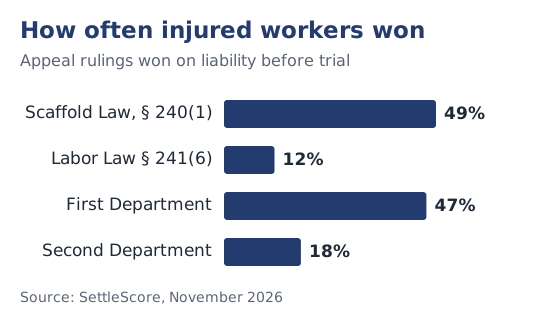
The chart below shows how often the injured worker won on liability before trial, for each law and in each of the two appeals courts that hear most New York City cases.
By law
| Law | Rulings | Worker won before trial | Left for trial | Claim dismissed |
|---|---|---|---|---|
| § 240(1): falls from height and falling objects | 580 | 49% | 32% | 19% |
| § 241(6): specific safety-code rules | 365 | 12% | 48% | 40% |
| Both together | 945 | 35% | 38% | 27% |
Scaffold Law claims won before trial four times as often as § 241(6) claims. A § 241(6) claim turns on whether a specific safety-code rule applies to the accident, and in 40% of these rulings the court dismissed the claim.
By appeals court
| Appeals court | Rulings | Worker won before trial | Left for trial | Claim dismissed |
|---|---|---|---|---|
| First Department (Manhattan and the Bronx) | 544 | 47% | 35% | 18% |
| Second Department (Brooklyn, Queens, Staten Island, Long Island and the lower Hudson Valley) | 390 | 18% | 43% | 39% |
The Appellate Division is split into four departments. The First Department hears appeals from Manhattan and the Bronx, and the Second Department from Brooklyn, Queens, Staten Island, Long Island and the lower Hudson Valley. The Third and Fourth Departments had too few rulings to show.
By year
| Year | Rulings | Worker won before trial |
|---|---|---|
| 2018 | 88 | 34% |
| 2019 | 81 | 35% |
| 2020 | 102 | 32% |
| 2021 | 117 | 30% |
| 2022 | 128 | 27% |
| 2023 | 100 | 34% |
| 2024 | 101 | 37% |
| 2025 | 109 | 42% |
| 2026 (so far) | 103 | 43% |
Years before 2018 had fewer than 10 rulings each and aren't shown.
What this means if you were hurt
- Find out which law fits your accident. A fall from a scaffold, ladder or roof, or being hit by a falling object, usually points to the Scaffold Law. Other accidents may fall under § 241(6), if a specific Industrial Code rule was broken, or under general negligence law.
- You usually sue the owner and the contractor, not your employer. Workers' compensation is generally the only thing you can get from your own employer.
- Report the accident and keep the evidence. Tell your employer in writing within 30 days, photograph the scaffold, ladder or equipment, and get the names of coworkers who saw it.
- Know what construction cases recover. Our construction accident guide shows what cases like yours have recovered in New York City.
How we did this
These are Appellate Division decisions from 2014 to 2026 in which a law firm listed on SettleScore was counsel, not every appeal decision on these motions. They are appeals only: trial-court rulings that nobody appealed aren't in published decisions. Each ruling is counted by how it left the worker's claim. No firm is named. The figures are as of November 13, 2026.
This article gives general information about New York law. It is not legal advice. Talk with a New York injury lawyer about your own case.
Sources
- Rulings: SettleScore's records of published Appellate Division decisions, as of November 13, 2026. See how SettleScore works.
- The Scaffold Law and the worker's own carelessness: New York Court of Appeals, Blake v Neighborhood Housing Services of New York City (2003).
- Gravity-related accidents only, and concrete Industrial Code rules: New York Court of Appeals, Ross v Curtis-Palmer Hydro-Electric Co. (1993).
- § 241(6) and comparative fault: New York Court of Appeals, Rizzuto v L.A. Wenger Contracting Co. (1998).
- Employer immunity: New York Workers' Compensation Law § 11. Reporting deadline: New York State Workers' Compensation Board, Injured Worker's Toolkit.
- The four Appellate Division departments: New York State Unified Court System, Appellate Divisions.
Compare Firms Handling Cases Like These
The top-ranked firms by SettleScore on their documented construction accident results. Firms can't pay to rank higher.
#1 Sacks & Sacks, LLP
ManhattanSettleScore 98 out of 10096 case results
#2 Block O'Toole & Murphy, LLP
ManhattanSettleScore 97 out of 10083 case results
#3 Zaremba Brown PLLC
ManhattanSettleScore 97 out of 10097 case results